Architecture (M.Arch)
About the Master of Architecture Graduate Program
The NAAB-accredited M.Arch program at RWU provides a rigorous professional training in design, history, planning, and technology while helping students develop critical strategic thinking and communication skills to tackle a range of issues from sustainability and urbanism to historic preservation. Students learn from Practicing Firms in Residence, earn valuable experience in paid internships and assistantships, and even have the opportunity to study abroad.
QUICK LINKS
Master of Architecture Program Facts
Format
On campus (Bristol)
Schedule
Day and evening coursework
Credits Required
56-101
Students without a pre-professional degree will have additional requirements.
Time Commitment
1.5 to 3.5 years
Cost
2026-2027 Academic Year
$23,424 tuition per semester (12-19 credits)
$1,956 per credit
* summer rates can be found on our tuition page
Fees
2026-2027 Academic Year
$490/semester
Ways to Save
Guaranteed funding to support paid assistantship or internship for all students
Apply By
Fall Deadlines: February 1 (Priority Deadline), June 15 (Final Deadline)
Spring Deadlines: November 1 (Priority Deadline), December 15 (Final Deadline)
Upcoming Events
Master of Architecture Program
The Master of Architecture (M.Arch.) program prepares students to enter and advance both the discipline and the profession of architecture. Students achieve a depth of understanding of the components of architectural practice and of the diverse nature and variety of roles for architects in relation to other fields. The program encourages the mastery and skillful integration of environmental, social, historical, artistic, technical and philosophical concerns into carefully developed designs that enhance their context through the region, the site, spaces, and detail. Our students and faculty embrace the opportunity to express human values through the design of the built environment.
Master of Architecture Program Highlights
- Career Investment Program - Available to all M.Arch students, the Career Investment Program provides funding to support a paid internship or assistantship each year you are in the program.
- Teaching Firms in Residence - Graduate architectural design studios are taught by a group of lead architects from a top firm each semester.
- Study Abroad Opportunities - Take advantage of an opportunity to study abroad in top destinations like Barcelona and Beijing as a graduate student all without losing time toward your degree.
- Women's Leadership Network - RWU is committed to furthering the work of women in the architecture field with this innovative network that provides mentoring, guest lectures, and more.
- Samsung Design Studio - Studio space with individual Samsung flat-panel monitors for all students and access to more than 100 software packages in a state-of-the-art virtual environment called Virtual Labs complement a rich architecture curriculum at RWU.
- Stand Out with an Embedded Certificate - Graduate students in the M. Architecture program have the opportunity to earn a graduate certificate in Preservation Practices, Real Estate, or Urban and Regional Planning—embedded within the M. Architecture curriculum—at no additional cost or coursework, providing a valuable credential to help differentiate themselves in the job market.
Request Information
Degree Requirements
Powerful Combinations with Master of Architecture
Three paths provide a variety of opportunities with the Master of Architecture professional degree.
Path One provides a continuous sequence from undergraduate to graduate study leading to the Master of Architecture professional degree, for students who have completed Roger Williams University's B.S. in Architecture program. Path One students normally complete this 181-credit sequence in 5-1/2 to 6 years from the beginning of their undergraduate studies.
Path Two provides advanced entry to the Master of Architecture professional degree for students from other universities who have completed a four-year undergraduate degree in Architecture. Individualized placement occurs following an evaluation of the student's undergraduate transcript and portfolio for completion of NAAB Student Performance Criteria. Path Two students normally complete a 56-credit, full time sequence over four semesters of study. For degree requirements and elective offerings, refer to Path 3.
Path Three provides entry to the Master of Architecture professional degree for students who have completed a four-year undergraduate degree in fields other than architecture. Students normally finish this 91-credit full-time program in three years and one summer. Some additional prerequisites in math, physics, and drawing may also be required.
NAAB Accreditation Master of Architecture
The Master of Architecture program is fully accredited by the National Architectural Accrediting Board (NAAB). Read more about the accreditation.
In the News: September 14, 2018: RWU's Master of Architecture Program Reaccredited with Distinction
Roger Williams University offers the following NAAB-accredited degree programs:
M. Arch. (pre-professional degree + 38 graduate credits)
Next accreditation visit: 2026
STEM Designation Master of Architecture
The Master of Architecture (M.Arch) program at Roger Williams University is a STEM-designated program in Architectural and Building Sciences/Technology eligible under the CIP (Classification of Instructional Programs) Code 04.0902. The STEM designation allows F-1 international students who graduate from the RWU M.Arch the ability to apply for a 24-month extension of post-completion Optional Practical Training (OPT) employment authorization in the United States, up to 36 months in total. Architecture was officially recognized as a STEM subject by the U.S. Congress as part of the 2018 reauthorization of the Carl D. Perkins Career and Technical Education Act of 2006.
Application Requirements
M.Arch Scholarships and Institutional Aid
Merit-Based Scholarships
All accepted Master of Architecture students who completed their undergraduate degree with a 3.0 GPA or above will receive a merit scholarship, renewable annually while maintaining a 3.0 GPA in graduate coursework.
Endowed Scholarships
Master of Architecture students are also eligible for several endowed scholarships, including the Raj Saksena Memorial Scholarship, the Kaestle Boos Associates Scholarship, DePoalo Family Scholarship, and Saccoccio Associats Architects Scholarship. One multi-year award, the S/L/A/M Collaborate Scholarship will be awarded to an accelerated M.Architecture Path student totaling $15,000 ($5,000 per semester for three semesters.)
There are also several scholarships endowed through the American Institute of Architects Rhode Island.
Master of Architecture Design Studio Work
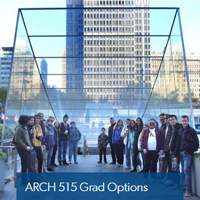
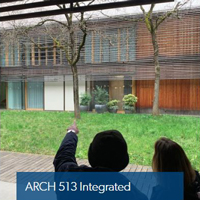
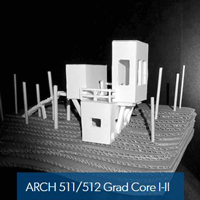
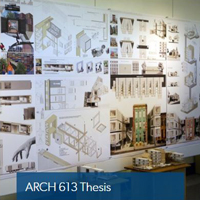
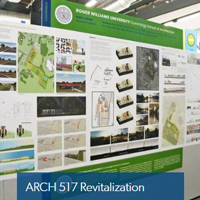
Architecture studios are at the center of the undergraduate and graduate programs in Architecture. Students explore architectural issues in a variety of ways led by full-time faculty, part-time practitioners, and Teaching Firms in Residence.
Select a studio to see examples of recent student work:
Cummings School of Architecture News and Events
Each semester the school hosts lectures and exhibitions featuring notable people and their work from the region, country and world. Free and open to the public. The link below will also take you to RWU's published blog: a complete list of the latest news stories featuring the Cummings School of Architecture and its community. Stories range from accomplishments of our alumni to work being done by our current students. We also feature stories about our latest programs and more.
Alumni Spotlight: Eliana Greenstein Himle

Eliana Greenstein Himle- M. Architecture, 2024
Eliana Greenstein Himle- M. Architecture, RWU Class of 2024What made you choose to study at RWU over other schools? When I joined RWU for my undergrad it just felt like the right community and size of school, but as I spent more time at RWU it became my
Read about Eliana Greenstein Himle- M. Architecture